
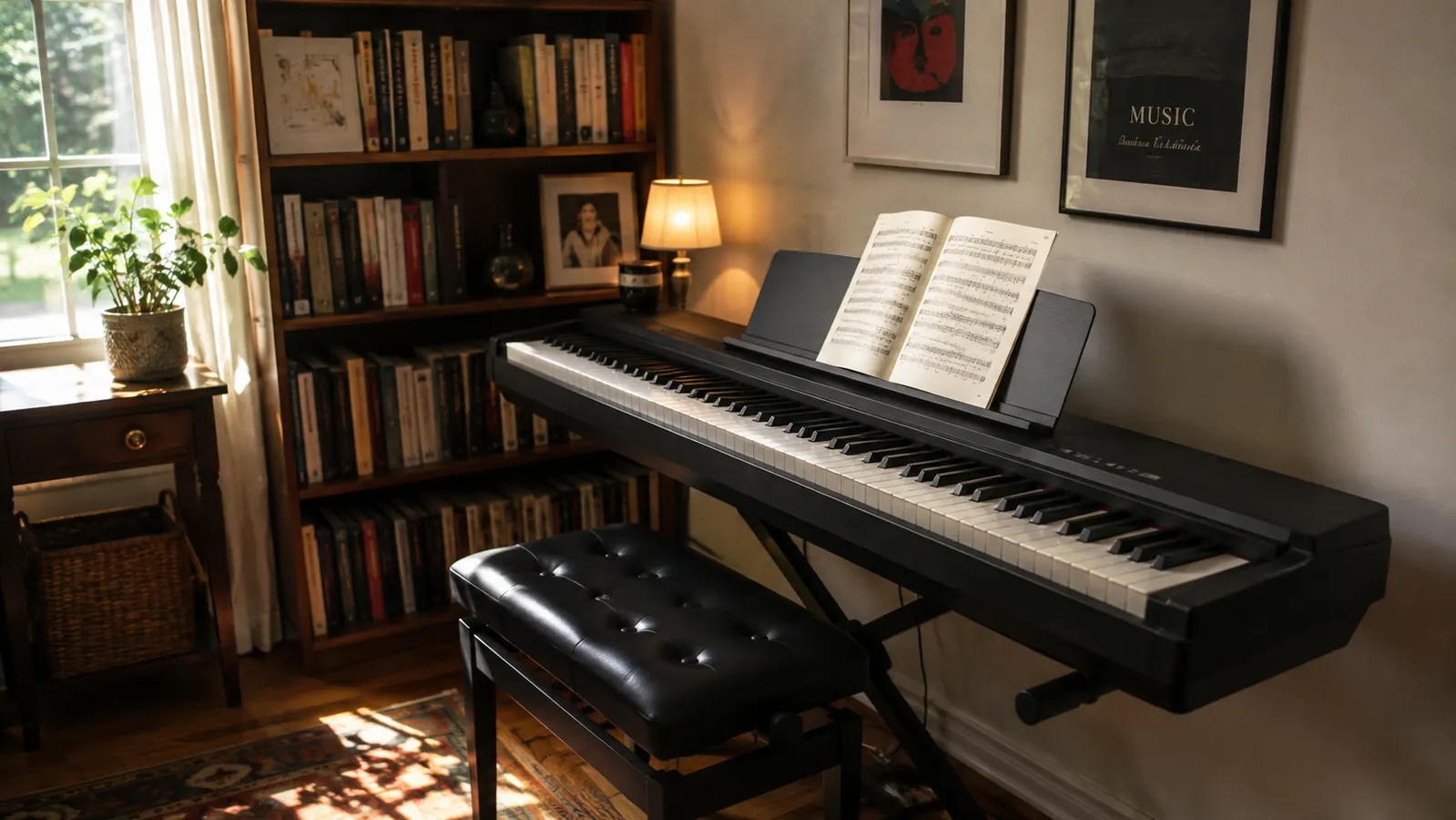
Six weeks after Christmas last year, three different families told me the same thing in one week: "we got her a keyboard and she never touches it." Different kids, different houses, same story. I have taught long enough to know the real reason. Most of the time it is not the child, and it is not even the keyboard. It is the setup. A keyboard folded back into its box under the bed, or parked on the dining table behind the salt and pepper, is a keyboard that does not get played. And the fix is not a fancier board with more buttons. The fix is a corner of the house built so that playing is the easy thing to do, and the Alesis Recital 88-key is the keyboard I sit in the middle of that corner for the families I teach.
A proper 88-key digital piano kept out, plugged in, and parked at the right height makes practice happen almost by itself. That is the whole job of a practice room. You do not need a spare bedroom, a soundproofed studio, or an acoustic grand. In the past few years I have set up the same corner in maybe forty student homes, and almost all of them are built the same way around the same keyboard. This guide is the exact checklist I walk parents through, one step at a time.
The Keyboard That Stays Out, Ready to Play
An 88-key digital piano with semi-weighted keys is the centerpiece of every practice corner I set up. The Alesis Recital is the one I have placed in the most student homes because it does everything a beginner needs without needing a tuner or a bigger house.
Amazon Check Today's Price on Amazon →Step 1: Claim the Right Corner of the House
A practice spot lives somewhere people already spend time, not in the farthest room behind the garage. In my own house the keyboard sits in the corner of the living room, and in student homes the best spots are almost always the same: a quiet corner of the family room, the wide part of a hallway landing, or a corner of a home office. The rule is simple. If you have to walk past the TV, or through a sibling's room, or downstairs, to reach the keys, they will not get played. And if you can close a door on the corner, even a laundry door, you give a shy beginner permission to be loud and wrong in private, which matters far more than any furniture.
Natural light helps, but it is not the priority. What matters is that the spot is quiet enough to hear a note and warm enough to sit in all winter. Keep the keyboard off direct sun and away from radiators, and leave room for a small lamp or a floor lamp. Most beginner practice I see fails at six in the evening because the player cannot see the page. You want light on the sheet music, not glare bouncing off the keys, so position the lamp behind the player's shoulder, aimed at the rest.
Step 2: Get the Keyboard Up to Playing Height
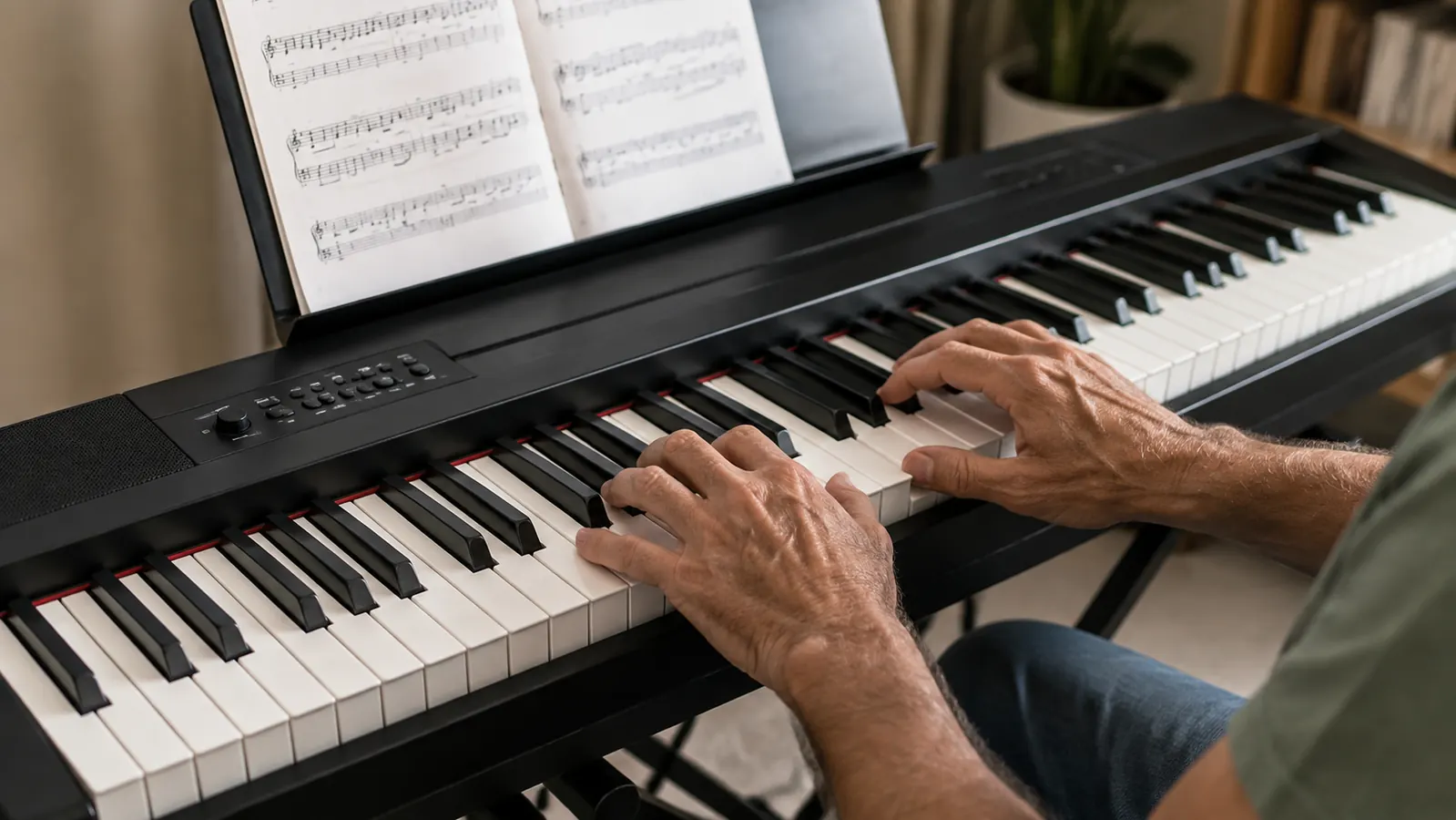
The single worst mistake I see in homes is a new keyboard left on the floor, or balanced on a coffee table, or sitting on the dining table where the kid has to reach up to it. The Alesis Recital is a portable 88-key board, which means its real home is an adjustable X-stand or a basic z-shaped keyboard stand with a matching bench. That setup alone, done once and done right, is the difference between a kid hunching over the keys and a kid sitting at them like a piano player. You do not need a piece of fine furniture or a built-in. You need the stand to put the keys where a real piano's keys sit, and a bench that puts the player at ease for the whole practice.
Set the height the way I set up every student. Sit on the bench, put your forearms parallel to the floor, and adjust the stand until your wrists sit flat, not bent up, when your hands are resting on the keys. For an adult that usually means the white keys land around your belt line. For a kid, raise the bench or add a cushion so both feet reach the floor, because a dangling foot becomes a swinging tempo. Then plug in a basic sustain pedal and set it under the bench, with its cable run along the leg so nothing trips a rushing six-year-old. You can teach a surprising amount of music without a pedal, but the first time a student needs a held note, that little box under the bench is what saves the phrase.
Step 3: Tune the Keyboard to the Player's Hands
Ten minutes with the Alesis Recital's front panel is worth a month of frustration downstream. The Recital has adjustable touch response, which is the setting that decides how hard you have to press before a note gets loud. A beginner presses hard, so the lightest of the available touch settings flatters them, and the semi-weighted action on these keys gives them real resistance without wearing out small hands. This is the part parents skip most often, and it is also the reason I steer families toward semi-weighted keys instead of a springy unweighted board. Leave the sound on the main piano voice for the first year. The other voices are fine for Friday fun, but the piano sound is the lesson.
While you are in the settings, turn on the built-in metronome and show the player what it does. I tell every beginner the metronome is a friend, not a punishment, and I start it at a slow count and let them tap along once before they ever play a note. Keep the manual's quick-start sheet in a nearby drawer. When a parent calls me at seven at night with a frozen screen question, the answer is usually a power-cycle, but the sheet keeps them calm until I am free.
Step 4: Make It Quiet-Friendly From Day One
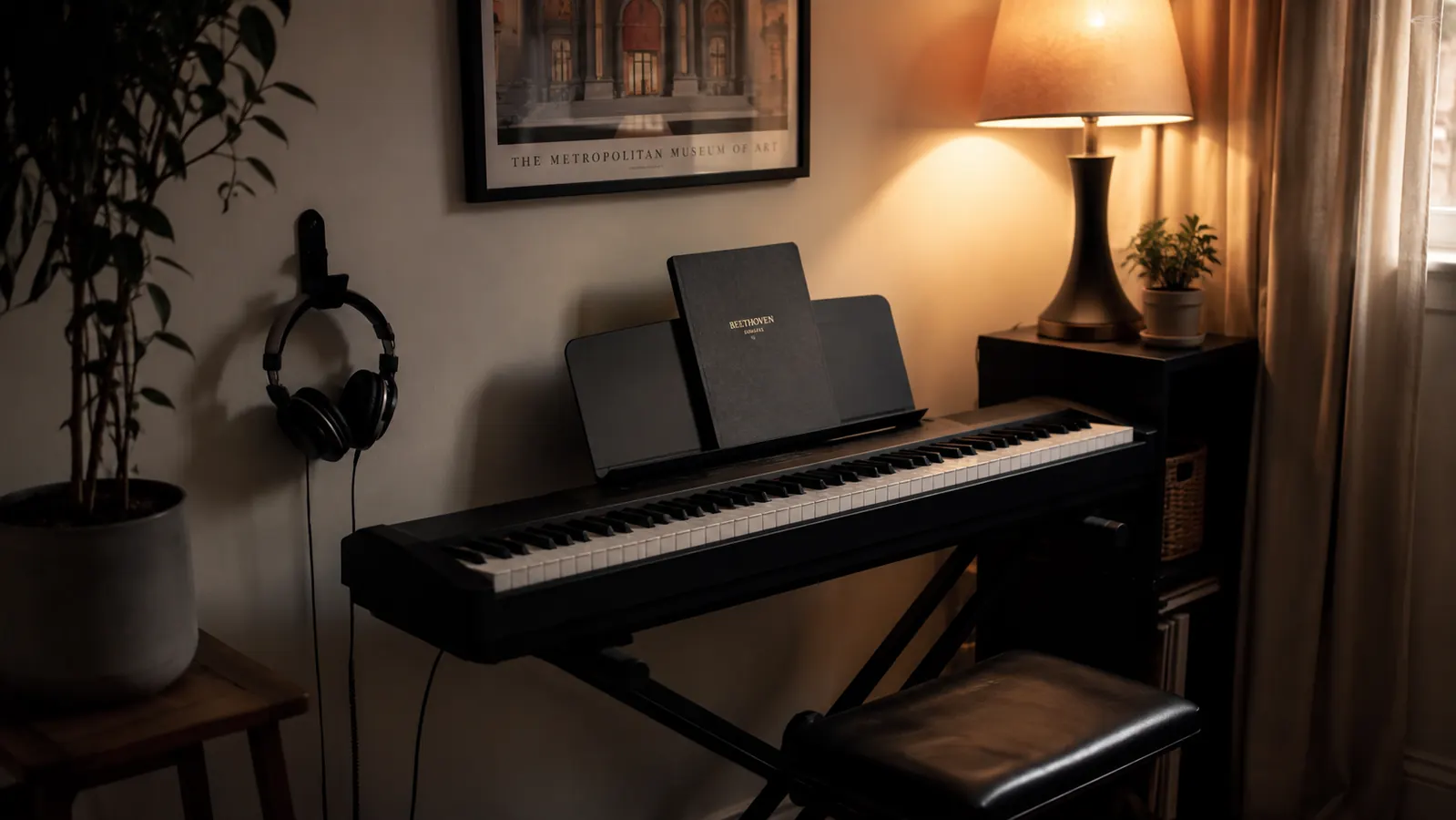
A practice room you can only use in the afternoons is a practice room that fails on school nights. The Recital has a headphone jack, and that is the entire solution. Zero volume in the house, full volume in the ears. I have a nurse on shift work who practices at eleven at night in headphones and has kept it up for a year. Any headphones you already own will work, the pair in the drawer or the good pair in the living room, so do not let "we don't have a quiet room" become the reason the keyboard stays cased. The jack takes a standard plug, so almost nothing needs an adapter.
Set the headphone volume at a level that lets the player hear their own fingers. Too loud and the tone turns harsh and the player backs off the keys; too soft and they cannot hear their mistakes, which is the whole point of putting the phones on in the first place. If the practice hour is fixed, the rest of the family learns that the headphones come out at that time, and no one else in the house has to hear the same three measures for the twentieth time.
Routine is the second half of quiet. Pick one time of day, put it on the family calendar the way you would a sports practice, and stack it: same bench, same lamp, same book on the same page. The corner you set up in Step 1 will do half of this work for you, because the keyboard is out and the bench is already there. The player still has to choose to sit down. A fixed time in a visible spot makes that the easiest choice in the house.
Step 5: Give Them Something to Play Along With
The keyboard sits in a corner and the player sits at it gladly, and now the music side. Any method book works; I mostly reach for the Faber adult and primer series because the pacing suits my students. Add one more thing and practice stops being lonely: a tablet or phone running a practice app or a slow piano tutorial. A playlist of pieces the player already loves, set to half speed, works just as well. The Recital has an aux input, so you can run audio from that tablet straight into the keyboard's speakers and play along over the top, and the USB port turns the board into a MIDI keyboard for the practice apps that listen to what you play. That combination is what turns a reluctant player into a repeat player.
One caution from the studio floor. Do not buy the tablet stand, the app subscription, and the fancy bench on the same weekend and call it a practice plan. Gear is the easy part to buy and the hard part to sit down with. Start with the corner, the height, the touch setting, and one book. Add the extras when the habit has survived three weeks, not while the honeymoon energy is still carrying everyone, because the habit is the thing you are actually setting up.
What Else Helps
A few small extras punch well above their weight, and none of them takes a big decision. A music rest light, the kind that clips onto the piano, solves the evening glare on the page completely, so the player stops squinting once the sun goes down. A dust cover keeps the keys clean when the corner is by the front door, which mine is. And add a small wall shelf at eye level above the keyboard holding the current book, a pencil, and the assignment notebook. When the book lives on the shelf instead of in a backpack, practice survives the walk home from the bus. A surge-protected power strip is a small add-on, set in place the day the keyboard arrives, and it quietly saves you from the power blips that turn a keyboard into a brick until you reset it.
What does not help: soundproofing, a bigger room, an acoustic piano, or waiting until the kid 'wants to practice' before you set any of this up. I have never once met a student who was carried into a practice habit by a bigger room. I have met plenty who were carried into it by a corner that was ready before they were. Practice does not begin with motivation. It begins with a spot, a bench, a light, and a keyboard that is already on.
And the one extra on this list I never have to buy is the simplest and most powerful of all. Once a week, sit down beside the bench and just listen for two minutes. No critique, no lecture about hand position, no note about the missed sharp, just attention. I tell parents that the weekly listen does more for a beginner's confidence than any upgrade in gear ever will, because it asks nothing of you except showing up and being present. The corner does the heavy lifting, but a player who is listened to will keep sitting down in it.
Four of my last six new students who had no practice spot quit within three months. The ones with a keyboard out and ready to play were the ones still coming to lessons the next fall.
This is the checklist I hand to parents after the first lesson, and I can tell you honestly that the families who do it are the ones whose kids still come back in September. Start with the corner, get the height right, set the touch, plug in the headphones, and give them a book and something to play along with. Accept that the first month is about the habit, not the repertoire, and that a missed day is normal. Set the corner up first and let the habit catch up to the setup, because one of them will always lead the other. The Alesis Recital handles every one of these jobs on a beginner's budget, and it is the keyboard I keep recommending because after a year of lessons, no family has ever come back and told me it was the keyboard's fault.
Build the Corner, Then the Habit Will Follow
Everything in this guide hangs on one piece of hardware: an 88-key digital piano that sounds good, feels right, and stays parked in the corner. That is the Alesis Recital for nearly every family I teach.
Amazon Check Today's Price on Amazon →