
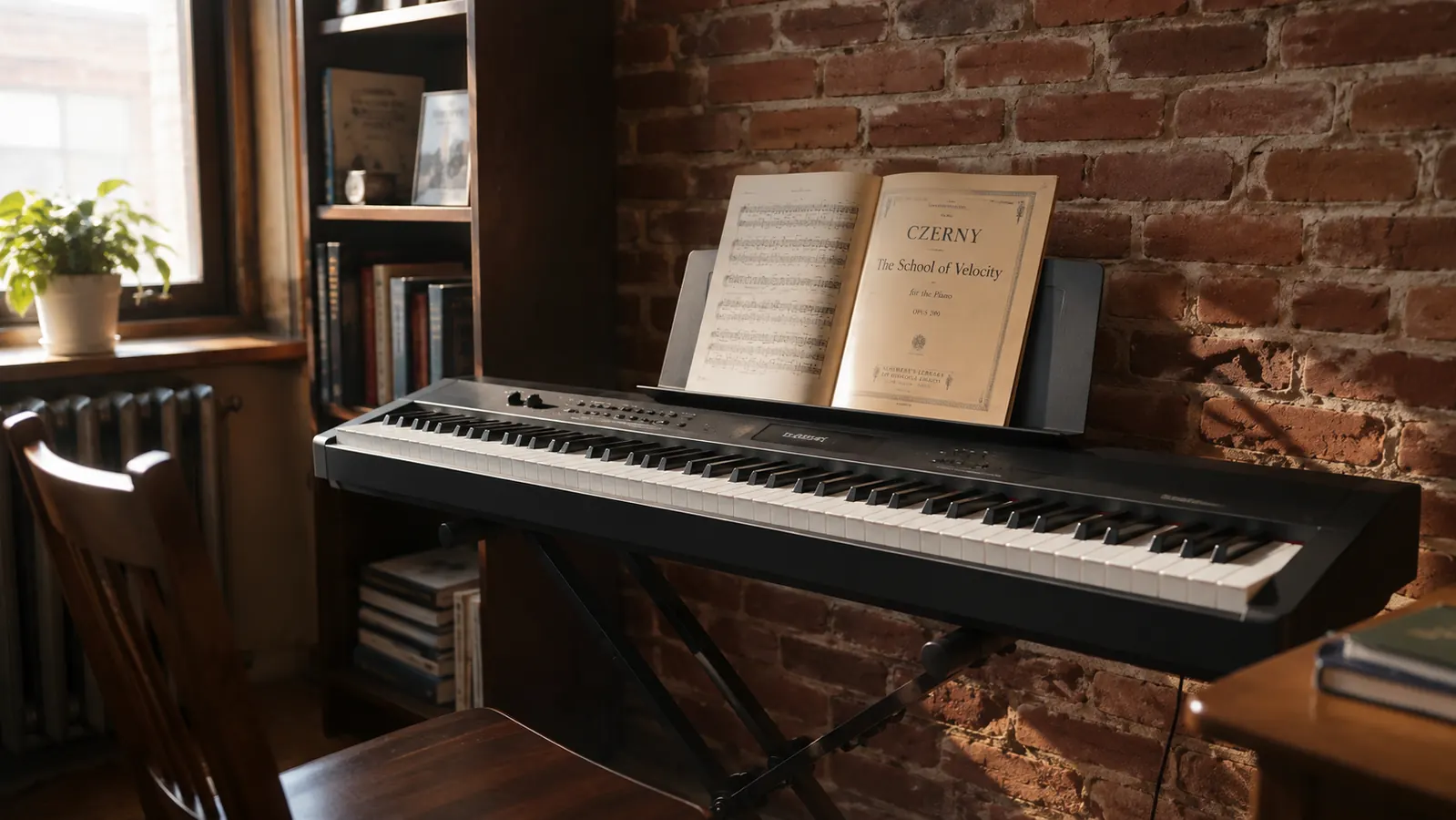
If someone in your house is about to start piano lessons, the first question you will run into is which 88-key digital piano to buy, and the two answers you will keep seeing are the Alesis Recital and the Yamaha P-45. I teach group and private lessons five days a week, and I've owned the Recital in my studio for over a year while the P-45 has lived at the homes of two students across the same stretch. This is my side-by-side from a year of real lessons on both, and the short answer up front is: for most families I would buy the Alesis, and for the few who are committed from week one, I would take the Yamaha.
The reason it is not a one-line answer is that these are not two versions of the same instrument. The Recital is a budget teaching keyboard that packs an enormous amount into a light plastic body. The P-45 is a stripped-down digital piano built around one thing, the graded hammer action, and nearly all of its outlay goes to that action rather than to features. Same 88 keys, same general idea, genuinely different instruments. Here is how they compare after a year of lessons.
How I Compared the Alesis Recital and the Yamaha P-45
I did not set these two up in a showroom and play a few scales. I compared them the way my students actually use them. The Recital sits in my studio on a folding X-frame stand, where dozens of kids and a handful of adults have played their first songs on it for a year, and it has been hauled to two classrooms and out onto a covered porch for summer lessons. The P-45 sits at the home of a nine-year-old student and at the home of a retired engineer, and I have led their lessons on it. I judge every instrument on four things: tone, the feel of the keys, how the controls survive real use, and whether the student actually gets better on it.
There are also two questions the spec sheet never answers, and they matter more than most of the specs. Will the piano fit into an apartment corner or a bedroom without taking over the room? And will the person it is bought for actually sit down at it four times a week? On that second question, the Recital wins more often than anyone expects, mostly because the learning tools and the louder speakers make solo practice a less lonely and less frustrating thing.
Before anyone plays a note, the two boards differ in ways a teacher notices in the first minute. The Recital's top panel is a full control deck: buttons for twelve voices, a recorder, a lesson mode, a metronome and a transpose function, all within reach of small hands. The P-45 keeps a shorter panel, a power switch, a volume slider and a button that steps through its voices, cleaner for an adult who never wants to think about controls but slower to change mid-lesson. The connectors sit in different places too: the Recital puts its headphone and auxiliary jacks on the front edge under the keys, so the cable drops straight down instead of pushing against the wall, while the Yamaha keeps its jacks on the back. None of this decides the purchase, but for a teacher it is the difference between a board that cooperates and one you fight.
How They Show Up in a Real Week of Lessons
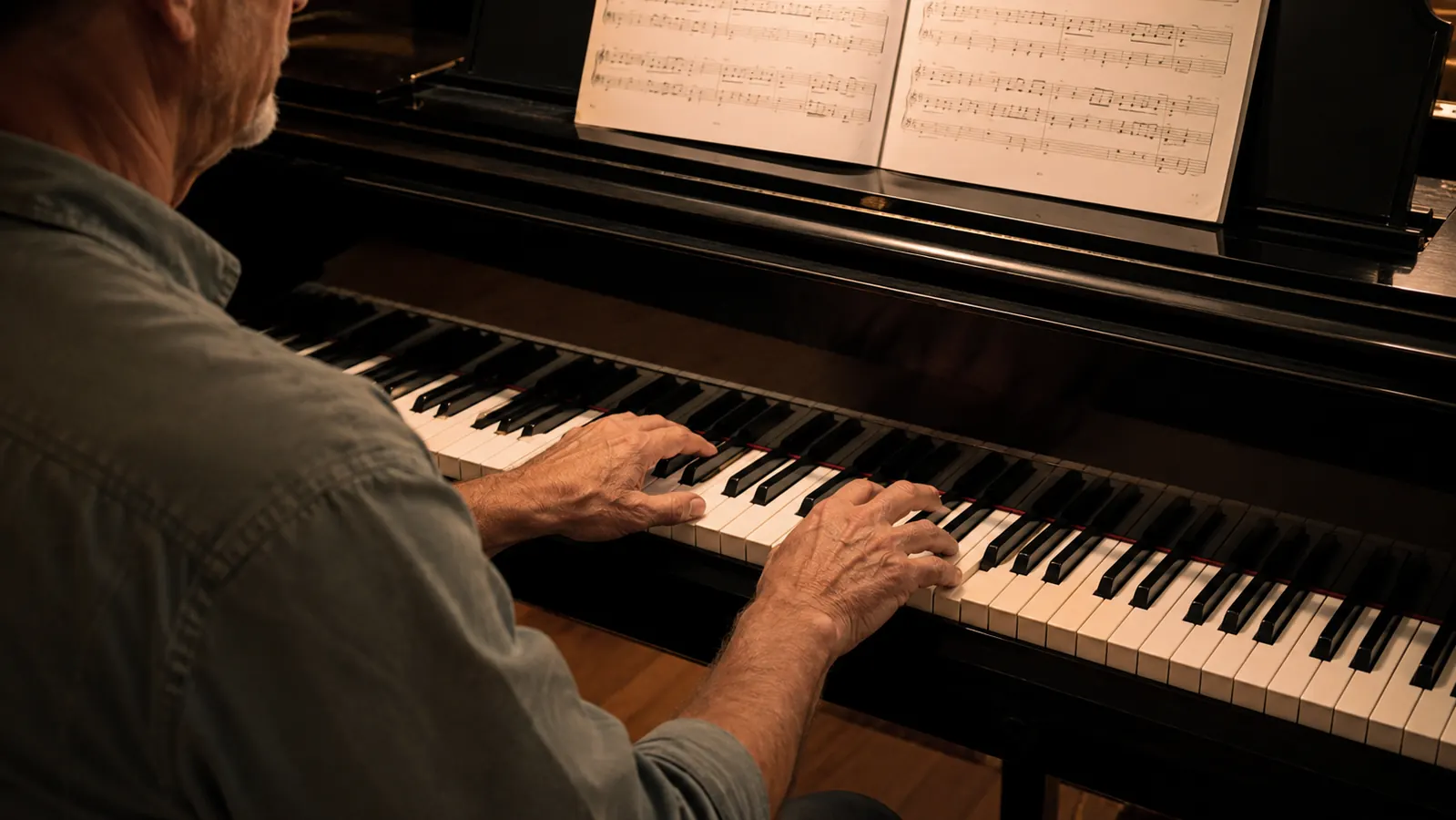
Here is the story that explains the whole debate. My studio beginners, most of them on semi-weighted keys like the Recital's, learn notes and rhythms right on schedule. But the moment we start working on dynamics, the contrast between quiet and loud, the difference in the keys stops being theoretical. On the Recital, a seven-year-old can play soft and loud easily, because the light action is easy to control. On the P-45, the same passage demands real finger strength, and the nine-year-old I teach on it spent her first month frustrated by chords she felt were clumsy. By month three she had a control her studio peers did not, because those heavier keys had been training her hands every single day.
That is the real trade, summarized in one story. The P-45 makes the beginning harder and the long run better. The Recital makes the beginning smoother and lets a student feel progress fast, which for a child still deciding whether they like piano at all is worth a lot. My practical habit when a family is unsure: start on the lighter board, and step up to a weighted one the day the student asks for it. That day arrives faster than most parents expect.
One more habit worth naming: I sent my nine-year-old home with the assignment to practice with headphones for ten minutes a night, and her dad never had to ask her to be quiet once. Both of these boards have a headphone jack on the front, which for an apartment family is half the reason to buy a digital piano at all. The Recital's louder speakers are the better feature when you want the sound out in the room, and the headphone jack is the equalizer when you do not want it anywhere else.
There is a sound-of-the-house difference I have come to expect by weeks two through six. The Recital's speakers are big enough that practice becomes something the whole family can hear, and more than a few of my shy beginners have gotten a confidence boost from a parent leaning in the doorway to listen. The same wattage, in the wrong house, is a different story: the P-45's quieter built-in sound made the headphone route the path of least resistance at my nine-year-old's house, and her parents were grateful for it. Two families, both practicing nightly, arrived there by opposite routes, and I have stopped assuming one route is better. Loud speakers suit a kid who wants to be heard. A quieter board suits a family with thin walls.
| Alesis Recital | Yamaha P-45 | |
|---|---|---|
| Key feel | 88 semi-weighted keys, light and springy, easy for small hands | 88 graded hammer keys, heavier in the bass like an acoustic, builds real finger strength |
| Polyphony | 128 notes, holds up under the sustain pedal and full chords | 64 notes, sustained passages can drop notes |
| Sounds | 12 voices, organ, strings, synth and bass on board | 10 voices, and the grand piano voice is noticeably more polished |
| Speakers | 20 watts of stereo, fills a small studio | 12 watts total, fine in a bedroom, thin in a classroom |
| Portability | lighter, and runs on six D batteries for hauling to class | about 25 pounds and wall power only |
| Learning extras | recorder, split lesson mode, metronome, bundled lesson apps | metronome and effects, no recorder or lesson modes |
| Cabinet | lightweight molded plastic, a working instrument rather than furniture | solid, sturdier main unit built for a decade of practice |
| Price and value | the budget pick, and the price check on Amazon is how to compare | the serious long-term pick, bought for the graded hammer action |
| Best for | first instrument, kids, and anyone hauling keys around | a committed student who wants weighted action now |
Where the Alesis Recital Wins
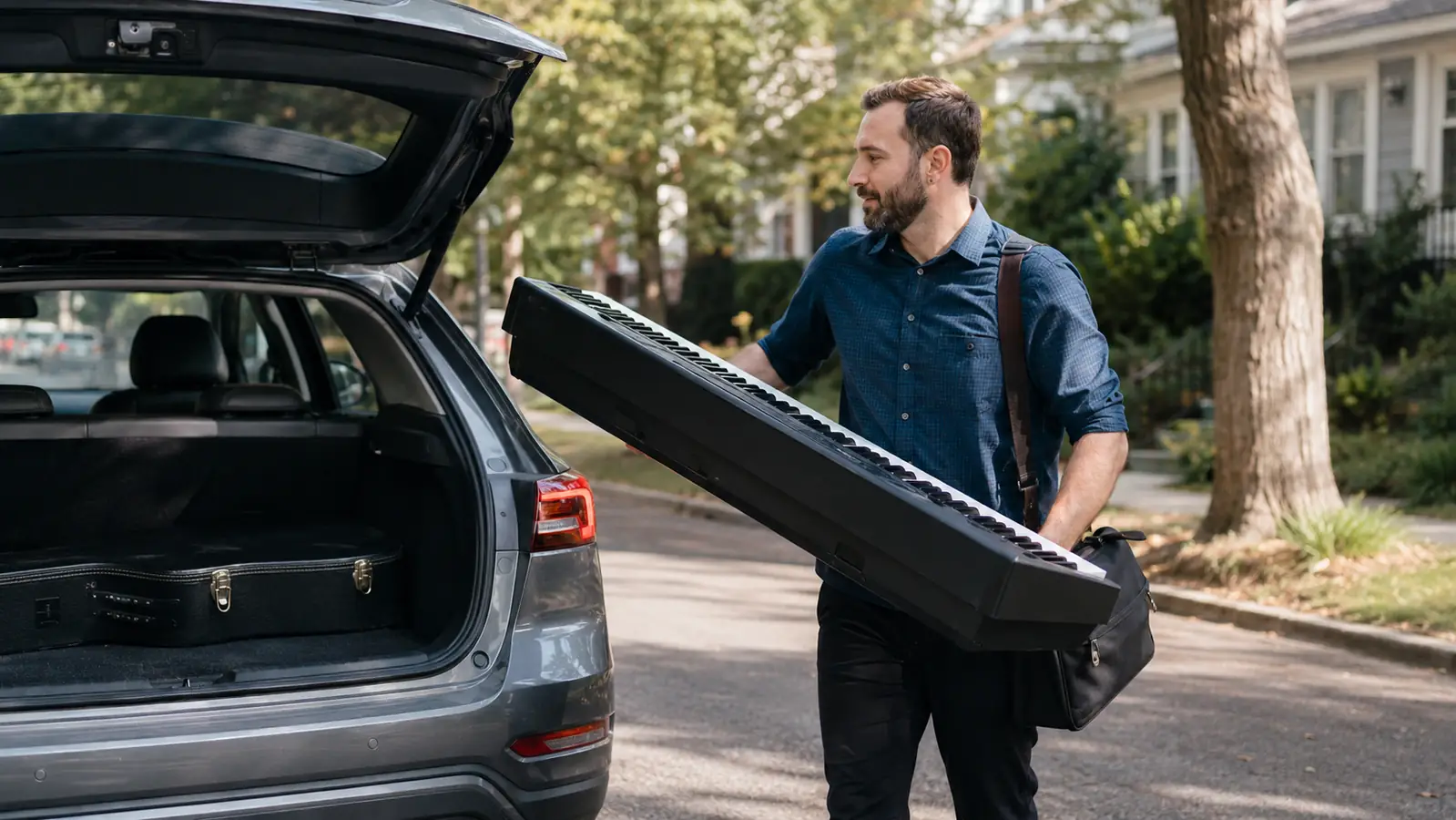
The Recital's side of the ledger is the longer list, and for most families it is the relevant one. It is the budget pick, and the price check on Amazon is the fastest way to see how far a first instrument outlay goes. It is lighter and runs on six D batteries, so it travels to a classroom, a friend's house, or a porch without being anchored to the nearest outlet by a power cord the way the Yamaha is. I have carried mine into a school music room twice this year, keys first, and no P-45 owner I know gets to do that.
Inside a lesson, the Recital keeps winning. Its 128-note polyphony means a student can hold the sustain pedal and play full chords without losing notes, which the P-45 visibly does under the same load. The built-in speakers are noticeably louder, and in a room of ten students that decides whether the whole group hears what one beginner just played. The recorder is the homework tool I rely on: play the piece, listen back, hear what you actually did. The lesson mode splits the keyboard so I can introduce two hands without anyone getting lost. The P-45 has a metronome and a few good sounds. The Recital is a practice room in a box.
The lesson apps that ride along with the Recital deserve a mention. The included pack of beginner lessons is designed around those exact keys, which gives a new family something concrete to do in the first week, before method books and a schedule exist. The Yamaha ships as an instrument and nothing else; you supply the books, the theory, the structure. I have watched families who would have stalled in week two get carried through by the instrument telling them what to play. That is a real difference in early momentum, and momentum is what keeps a first-year student signed up.
Where the Yamaha P-45 Wins
The P-45 wins the argument that starts the fights, which is the feel of the keys. Its graded hammer action is heavier in the bass and lighter in the treble, exactly like an acoustic, and the rebound exercises a student's fingers on every single note. The Recital's semi-weighted keys are lighter and springier, comfortable for a small first year, but they do not build the finger strength or the control that weighted keys do. Every student I have moved from a semi-weighted board to a fully weighted one reports the same thing within a month: their hands got stronger. That is the instrument doing its job.
The P-45's grand piano voice is also the better instrument tone, and for a piano student that matters more than any other spec. Alesis fits twelve voices on the Recital and several of them are genuinely fun, but the acoustic piano is the sound a student will use ninety percent of the time, and Yamaha's is finer: more sustain, more body, less digital shine. The cabinet is sturdier, too, a solid main unit that feels built to last a decade of practice, where the Recital's molded plastic body is clearly a working instrument rather than a piece of furniture. If you are buying for a student who will stick with it for years, the P-45 is the more honest long-term purchase.
The other thing weighted keys do is prepare a student for the real piano down the hall. My students who practice on the P-45 walk up to the studio upright and play with almost no adjustment, because the resistance under their fingers is in the same family as an acoustic action. My Recital regulars need a few weeks to learn what a heavier key feels like, and I plan their first visit to the recital room accordingly. If your school has a real piano and the end goal is that stage, the P-45's action looks like home the day they arrive. That is a small thing at month one and a decisive thing at year three.
Heavier keys build stronger fingers. Every student I have moved from semi-weighted to weighted confirmed it within a month.
Don't Let the Spec Sheet Make the Decision for You
The Recital covers what a first student actually needs to practice daily: 88 semi-weighted keys, a loud stereo speaker pair, a recorder, a lesson mode, a metronome, and bundled lesson apps for the first months. It is not a grand piano pretending to be small, it is a smart first instrument. Check today's price on Amazon.
Amazon Check Today's Price on Amazon →Who Should Buy Which
Buy the Alesis Recital when the player is a child starting out, a teenager in a maybe phase, or an adult honest about being in a test year. Buy it when the piano has to share a room, travel to lessons, or survive a move. Buy it when you want the teaching features and the louder speakers on day one. Buy the Yamaha P-45 when the student is already committed, when your own fingers know what a piano should feel like, or when the goal is classical technique from the start. For a student who is clearly going to stick, the weighted action is the right investment and I would never talk a family out of it.
The warning I give every parent applies to both instruments. Do not buy the heavier, more serious instrument to create motivation in a kid who has not practiced a single week yet. Instruments reward motivation, they do not create it. The Recital keeps that first bet small, and you can step up to a weighted board once the habit is real. I have watched the reverse happen, a serious keyboard quietly turning into a coat rack, more often than a teacher wants to admit. Start small on purpose.
Age matters less than one question: does this instrument have to please two players? When the board lives in a living room and a parent wants to sit down after the kid goes to bed, buy the weighted action and never look back, because an adult ear notices the difference on night one. When it lives in a bedroom for one student, the lighter keys and the built-in recorder will get more real use. I have also stopped believing that adults secretly want the heavier action just in case they get serious later. The adult who practices four nights a week on the Recital improves faster than the adult who practices twice on a weighted board, and I have both kinds of student enrolled to compare.
The Bottom Line
Both of these are good instruments, and the whole comparison comes down to a sentence. The Alesis Recital is the best value 88-key board I know for starting out, and the Yamaha P-45 is the most honest way to bring a graded hammer action home. Most families should start where the Recital takes them, put their energy into regular lessons, and upgrade the day the student's ears and fingers start asking for it. A student who quits after six months has lost far less, and a student who catches the bug has earned a better instrument either way. What I actually measure is whether the student practiced every single day on a real 88-key instrument, because that daily practice decides whether piano becomes their thing.
Still Deciding? Start With the Student, Not the Keyboard
If this is a first 88-key purchase for your house, the Recital handles the practical side while you all find out whether piano is the hobby that sticks. My long-term Alesis Recital Review covers a year of teaching on it, and my guide to weighted keys explains exactly when the step up becomes necessary. Check today's price on Amazon.
Amazon Check Today's Price on Amazon →