
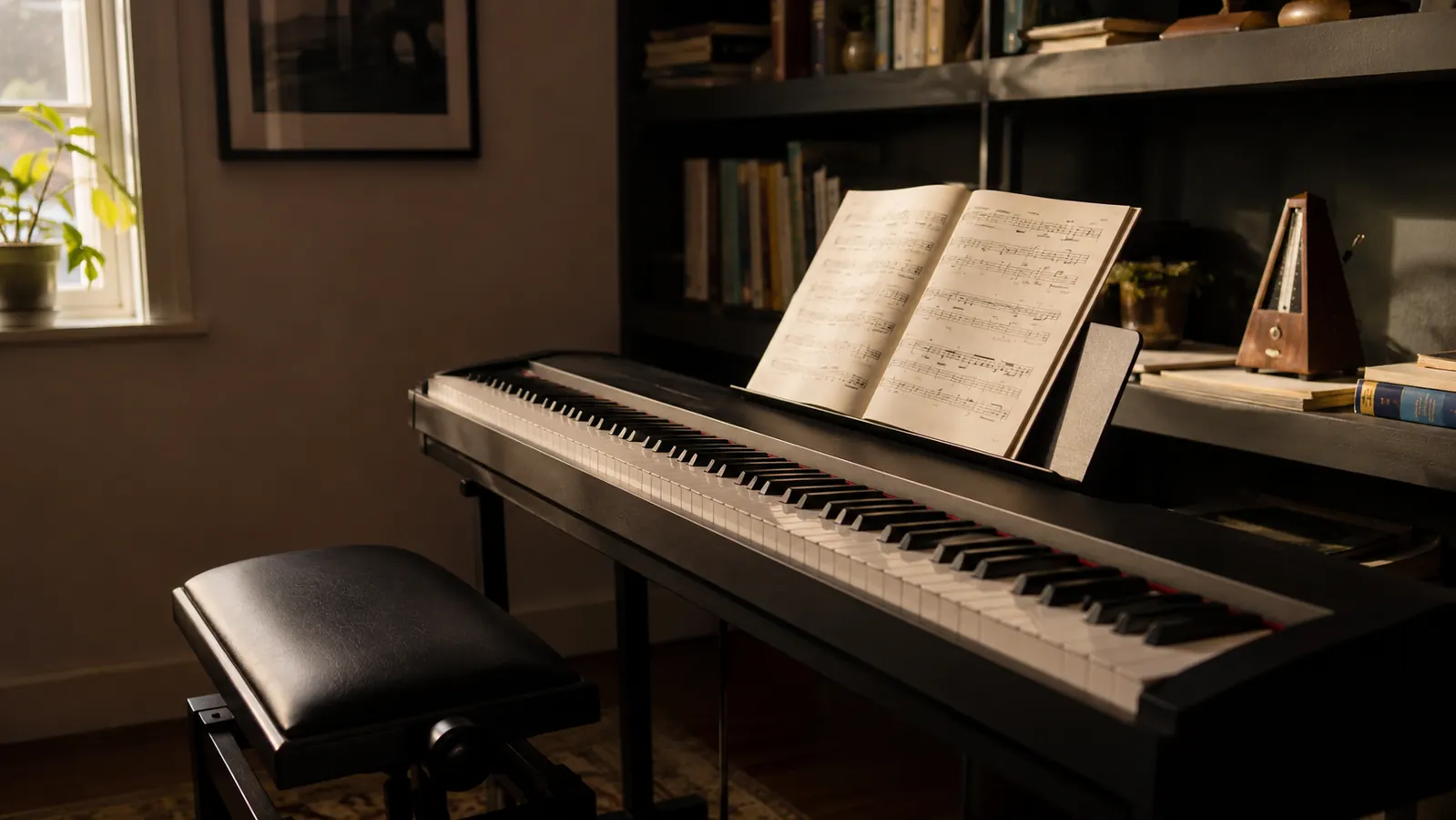
Every week a parent asks me the same thing in the same half apologetic tone. We want a real piano for our kid, we don't want to spend a fortune, and we have no idea what we are looking at. For the past fourteen months my answer has been the Alesis Recital, and I now have three of them in the wild to prove whether that advice held up or fell apart. The first one went to Elena Munoz's family when their nine year old finally outgrew a 61 key fun board with a cartoon tiger sticker on the front. The third one sits in my own studio corner this afternoon, where I teach six beginner keyboard students a week on it between guitar lessons.
Let me be clear about what this review is and is not. It is not a spec sheet read back at you, and it is not a love letter. I have no stake in Alesis beyond the money I have spent on these three boards and the hours my students have spent on them. This is a working teacher's report on whether an 88 key semi weighted digital piano at a beginner price actually survives daily teaching, weekly practice, and a year of kids being kids at the keys. The recital that matters to me happens every Tuesday afternoon in a lesson, not on the box.
The Quick Verdict
After fourteen months and several hundred lessons across three units, the Recital is still the first keyboard I recommend to beginner families. The semi weighted action is the only real ceiling. It teaches fingers properly, but it is not a hammer action, and strong young players outgrow the feel somewhere in year two. For the money it beats every toy board in the same aisle.
Amazon Check Today's Price →Still Trying to Pick a First Digital Piano From Reviews Alone?
The Recital is the 88 key semi weighted board I have bought three times for students, and the reason is the same every time. It plays like a real instrument without a budget that scares a family off, and it has been solid for a year and a half in my studio. Check today's price and current availability on Amazon.
Amazon Check Today's Price on Amazon →How I've Used It
The Recital earned its place in my studio by accident. One September, a family I teach borrowed a spare keyboard from me, a cheap used unit I keep for adults who are not sure they will stick with lessons. After a month they came back and asked to buy it from me. When they handed over cash, I ordered two more the same week, one for a younger student and one for myself, because that first loaner had spent an entire month doing what a lesson keyboard has to do and never once made me chase a fault. That was fourteen months ago.
Today the studio Recital gets played by six beginner students a week during lessons and by me in the gaps between them. The two home units get about an hour of practice nearly every day from kids who started with zero experience. The power adapter is still the original, the keys return evenly across the full 88, and the only part that has needed genuine care is the same part that needs care on boards three times the price. Dust on the keys. So when I tell parents the Recital will carry a beginner through the first two years, I am not reading from a brochure. Elena went from hunting for middle C to playing both hands through an arrangement of a song she picked, and the board never changed that whole time.
Semi Weighted Keys and What a Year of Lessons Taught Me
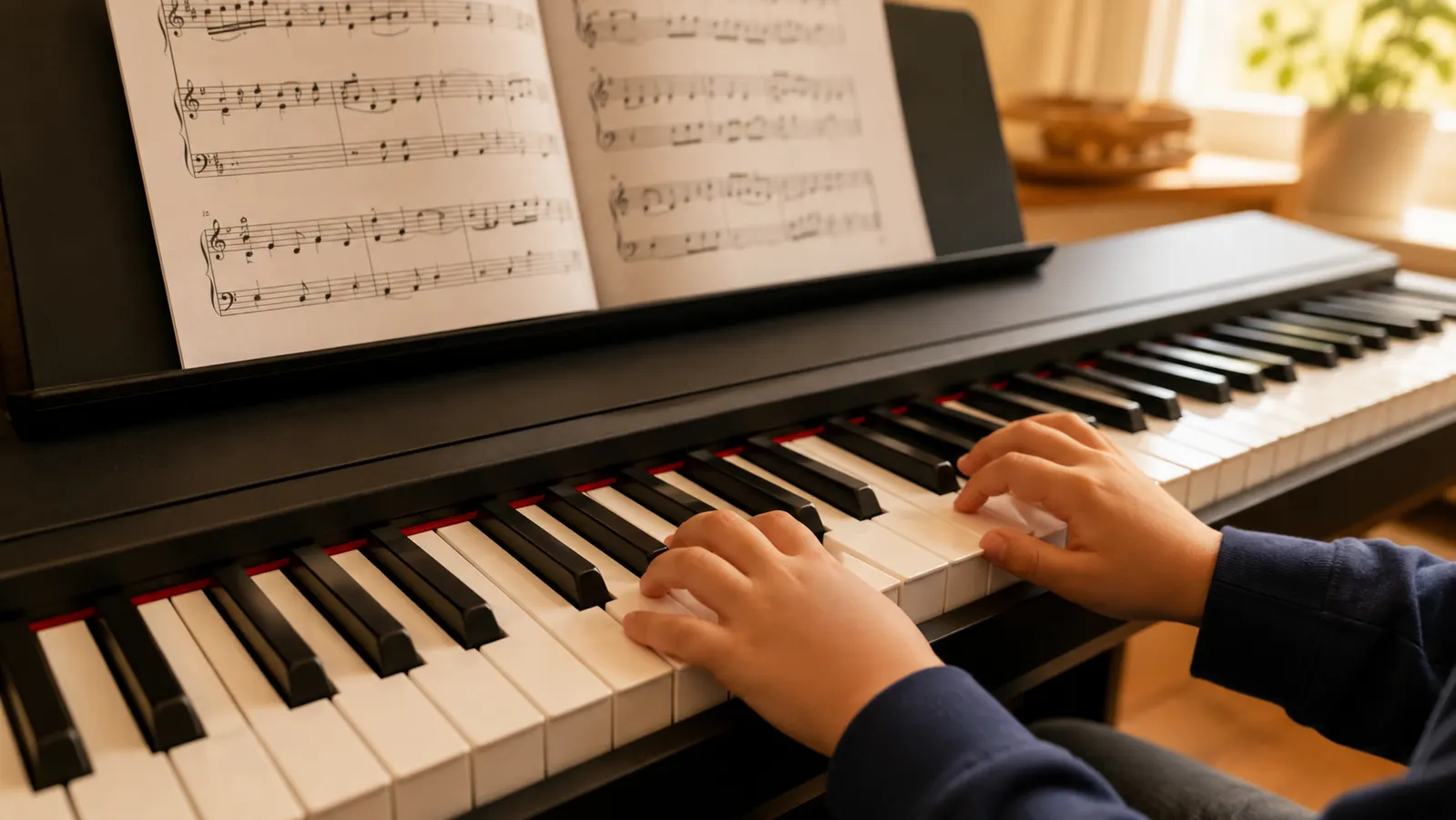
The keys are the whole argument for this board, and they are also the whole argument against it, so let me be precise. They are semi weighted, which means they carry real mass and spring back the way a piano key should, but they are not a hammer action like you will find on console pianos or on more expensive Yamaha and Casio models. For a beginner that is a feature, not a compromise. The resistance is enough to build finger strength and clean technique, and light enough that a six year old can press each key plainly without fighting the action. I have taught on fully weighted boards where very young kids simply cannot generate the force to play the low range expressively. That exhaustion is real, and it pushes kids away from the instrument faster than any technical flaw.
After a full school year of daily use, the action has not loosened, has not developed dead zones, and has not started clicking or rattling. One home unit did develop a key that caught slightly last winter, a low D that felt rough on the way down. It was a grain of grit under the key edge, not a broken mechanism, and I cleared it with the corner of a business card. That is the entire repair log across three units in fourteen months. You will read dramatic warnings online about semi weighted keys wearing out. I did not see it, and I suspect most of those failure stories come from boards that lived on carpet in a damp room.
Here is the honest ceiling. Somewhere in the second year, a motivated older student will begin to feel that the action gives them less to push against. That is not a defect. It is the moment the instrument has finished its job, because that same student would never have reached that point on a springy 61 key toy. When it happens I move the family's budget conversation up a level and point them toward a hammer action board, which is a normal graduation, not a refund reason.
The Built In Speakers and the Sounds
The Recital's built in speakers are small, but they are honest. In a ten by twelve studio room at practice volumes, the default acoustic piano voice is clear rather than tinny, with a believable sustain that keeps a beginner's first chords from sounding thin. It will not be mistaken for a concert grand sample, and nobody is claiming otherwise. What matters for teaching is that the student hears a pleasant instrument instead of a beepy toy, because in the first six months the ear is the part of the student actually being trained. A dinky sound invites dinky playing, and the Recital's piano voice avoids that.
The board carries eight voices, which sounds like a toy stat until you remember a kid will explore every one of them. I have used the electric piano voice for a sleepy after school student, the organ voice as a bribe for finishing a scale exercise, and the synth voices during the ten minutes when a young student needs to make spaceship noises before they can focus. Polyphony is 128 notes, effectively unlimited for the material a beginner plays, so pedaled chords and two handed parts never drop notes. These are small things, and they are why practice happens without a parent standing over the bench.
The Quirks I Live With
No review is honest without the rough spots, so here are mine. The volume control has a noticeable jump at the very bottom of its travel, quiet enough one click and louder than you expect the next, which makes it clumsy for very quiet evening practice. It is a wart, not a dealbreaker, and I have taught around it for a year. The base box also includes no stand, bench, or pedal, so the true starter cost is higher than the keyboard price alone, something I always put to families before they form a budget around the sticker.
The glossy plastic cabinet above the keys collects dust and fingerprints quickly, and in a house with young kids it will show every single one. None of these stopped me from buying two more units, which is the practical verdict. If you want the full list of niggles, including the ones that annoy me after a full year rather than a first week, it is all in my honest Alesis Recital review.
Headphones, USB MIDI, and the Home Practice Corner
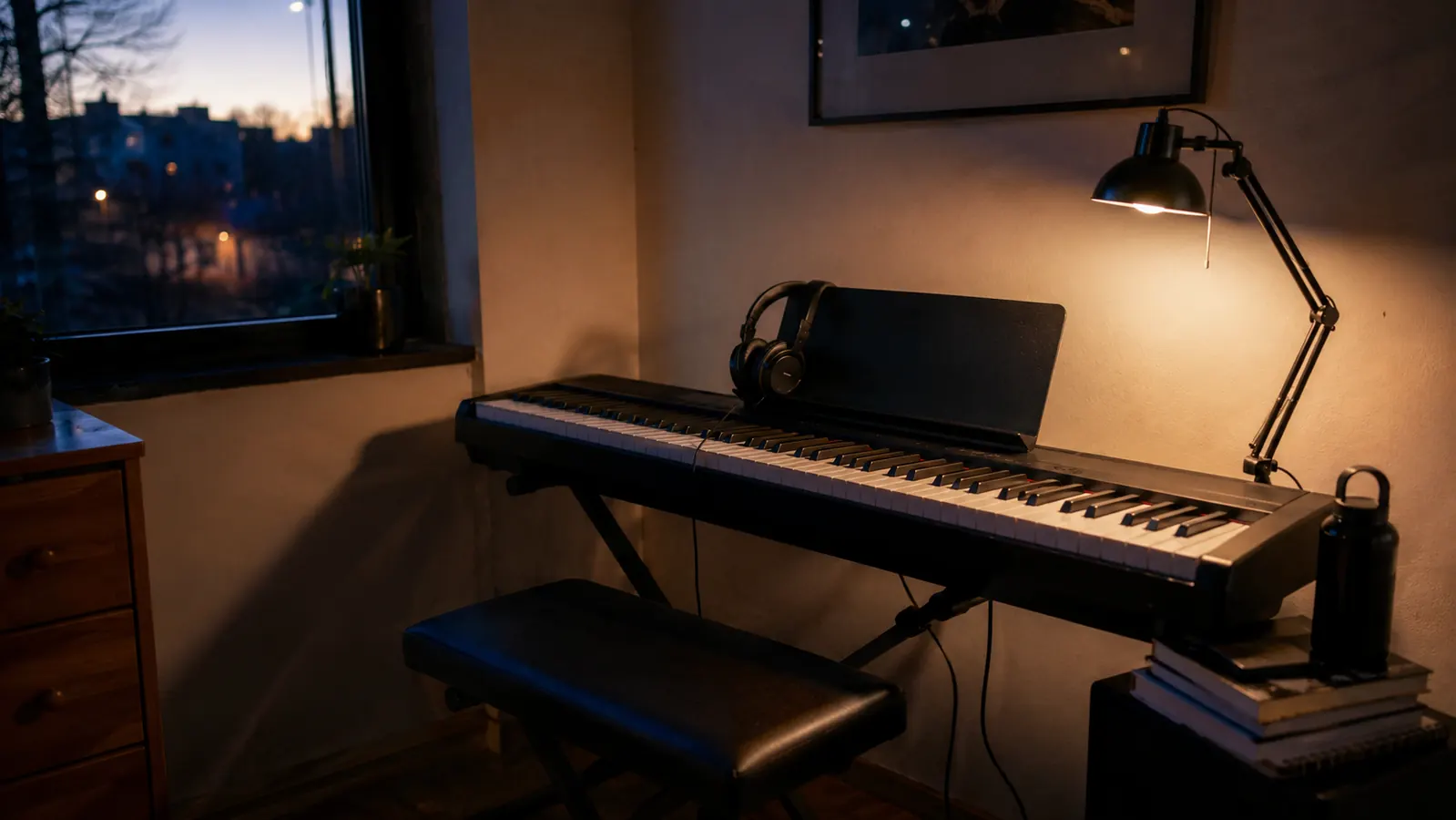
Half of my students practice in shared homes where a loud acoustic would start arguments, and the Recital handles that gracefully. The headphone jack sits on the front edge, and plugging in mutes the speakers, which sounds basic and is genuinely important in a busy household. I have taught entire lessons where the student wore headphones because a sibling was doing homework three feet away. The room stayed silent while the student heard themselves clearly. For apartment families, that one feature is worth the price by itself.
Two more things matter for lessons and both are on the back panel. There is a USB MIDI connection so the board can talk to free learning software, which I use with students who respond to gamified drill apps, and there is a line input so a student can play along with a backing track or a metronome through the same speakers. Add a basic sustain pedal and the corner becomes a real practice station. The Recital does not need anything else to be a proper first instrument.
Alternatives I Considered
I have recommended keyboards to maybe sixty families over the last two years, and for most of them the real choice comes down to two boards, the Alesis Recital and the Yamaha P-45. The Yamaha is the board people bring up once they have heard the phrase hammer action and want to know why it costs more. Its keys are heavier and more authentic, its name carries more weight, and for an older serious beginner, or a family that already knows this child is going to stick with piano, it is genuinely the better long term buy. I have said that face to face and I will say it here. It is a better instrument. The difference shows up almost entirely in the feel of the action.
For the family buying a first real keyboard for a kid who might play for two years or might quit in two months, and that is most families, the Recital is the more honest recommendation. The money it saves is real money, and the board it buys is a real instrument rather than a toy pretending to be one. I walk through the full Recital versus P-45 decision, including who should pay up and who should not, in my Alesis Recital vs Yamaha P-45 comparison.
What I Liked
- 88 full size semi weighted keys feel like a real instrument, not a toy, and built proper finger strength across a full year of beginner lessons
- Built in speakers sound honest at practice volumes, and the eight voices keep young players exploring instead of bored
- The headphone jack mutes the speakers, so shared homes and apartments can practice without starting a war
- USB MIDI and a line input make it work with free practice apps and backing tracks out of the box
- Three units, fourteen months, several hundred lessons, and the only repair was clearing grit from under one key
Where It Falls Short
- Semi weighted action is a real ceiling for older serious students, who will want a hammer action by year two
- The piano sound is good for the price, not stunning, and a wiser ear will notice the difference
- No stand, bench, or pedal in the base box, so the true starter cost is higher than the keyboard price alone
- The glossy cabinet shows dust and fingerprints fast in a busy house with young kids
Fourteen months and several hundred lessons across three boards, and the only repair I have ever made is clearing one grain of grit out from under a single key.
Who This Is For
If your family is buying the first real keyboard for a child, you are a grandparent picking up a board for a grandkid, or you are an adult who has wanted to learn piano and is finally making good on it, the Recital is my default recommendation and it earns that. It does the three things a first instrument has to do. It feels like a real instrument, it sounds pleasant enough to want to play, and it leaves room in the budget for what lessons actually need, a stand, a bench, a pedal, and eventually a teacher. Alesis got the beginner brief right, and a year of my studio is the proof I keep pointing families to.
Who Should Skip It
If the future student is in middle school or older and clearly serious, if they already practice on a real acoustic at school and love the feel, or if the family budget comfortably reaches the better instrument, skip the Recital and start with a hammer action board. The semi weighted action will feel like a step down from what they already know, and starting an eager kid on a board they will outgrow in twelve months is false economy. For the families who stay on the Recital path, and most should, the fundamentals here will carry them a long way before that upgrade day ever comes.
Want This Verdict Applied to Your Family's Situation?
After fourteen months I keep recommending the Recital to beginner families, and I buy it myself when a student needs one to keep. If it is the right board for your house, today's price is worth a look before you settle.
Amazon Check Today's Price on Amazon →