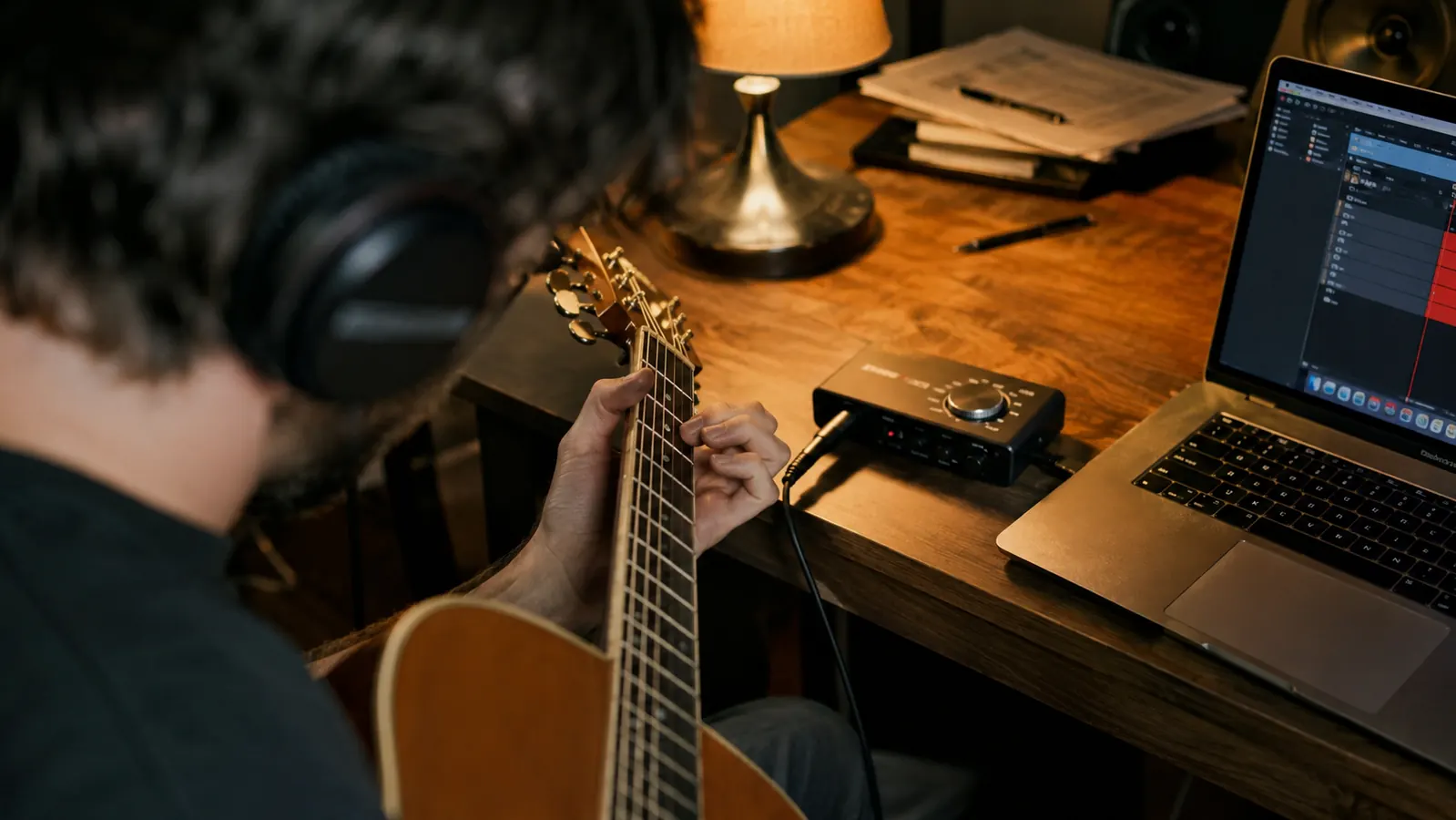
I teach from one rule and I practice from the same one: record or don't play. That sounds like a dramatic slogan, but I mean it literally. Every time I sit down with a guitar or a keyboard in my home office, the interface is already on, the mic is already live, and the record button is one click away. When I bought my first Focusrite Scarlett Solo eight years ago, I gave myself this rule on day one. The interface has sat on my desk, plugged in and ready, ever since.
You already know you should record your practice. That's why you're here. The gap isn't knowledge, it's commitment. A phone in your pocket turns recording into a project: open the app, find the right settings, prop it somewhere it won't muffle the sound, hope the battery lasts. An audio interface that never gets unplugged removes every one of those steps. These are the ten reasons I finally took my own recordings seriously, and the reasons I push every student to do the same.
The audio interface that records without thinking
This is the interface that taught me to record every practice. The mic stays plugged in, the computer stays connected, and starting a session is one click. That's the whole secret of a lasting habit: the setup is already done.
Amazon Check Today's Price on Amazon →Always plugged in, always ready
The practice session doesn't start when you open software. It starts when you sit down. Because the Scarlett Solo stays connected to the computer and the mic stays connected to the interface, my setup is never broken down and never put away. When I come home from teaching and want twenty minutes on the guitar, it's one click to start and one click to stop. No setup, no tear down, no reason to skip. The phone needs propping, opening, and charging. The habit survives because the friction is gone.
You hear what your listener hears
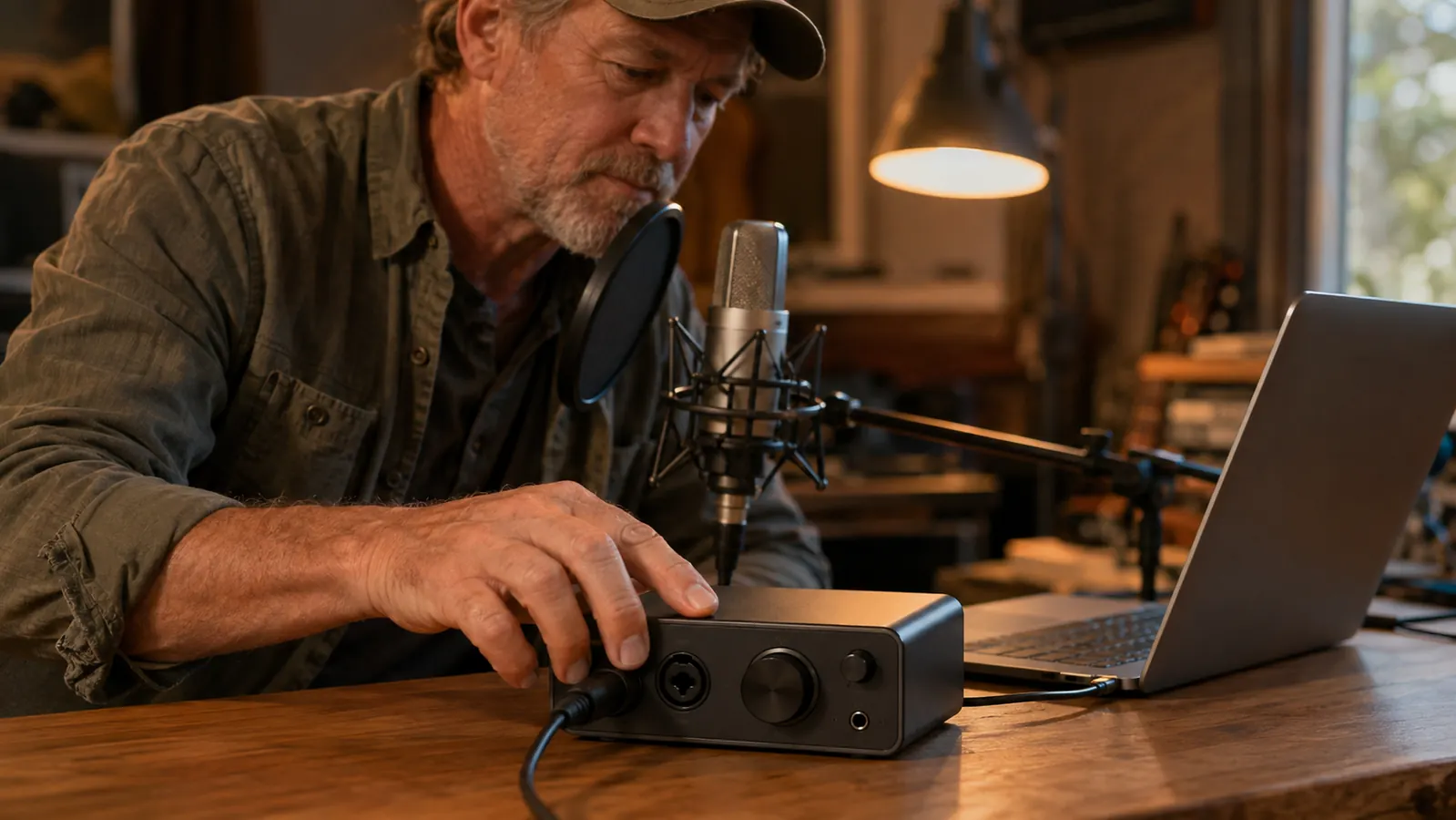
The first time I played a recording back for a student, she said it sounded nothing like what she heard in her own head while she played. That's the whole problem in one sentence. When you're playing, your ears are closer to the instrument than the listener's, your body is in the way, and the room is fighting you. A recording hears exactly what the audience hears: the notes that ring, the ones that thud, the timing that drags. The Focusrite preamp gives you that picture cleanly, at the volume you need, without noise.
Repetition becomes audible truth
Practice is mostly repetition, and repetition is invisible to the person doing it. I can play the same four-bar phrase forty times and each pass feels identical to the one before. Under a recorder, they are not identical. The third pass is rushed, the fifteenth is confident, the twenty-ninth is sloppy because I got tired. Across every session, the recorder shows me the truth my hands already knew. When you can hear the problem, you can fix it with intent, instead of hoping more reps will fix it by accident.
One phrase, two takes: confident vs hesitant
I record the same phrase twice on purpose: once hesitant, once confident. The difference is more than loudness. Hesitant playing has gaps, uncertain attacks, and a pulse that wavers. Confident playing sits on the beat even when it's soft. This is the single best exercise I use with students, and it only works with a recording, because the players themselves cannot hear the difference in the moment. A good take and a lucky take sound the same in the room. They do not sound the same on playback.
Progress has somewhere to live
Progress over a month is invisible. Today sounds like last month sounded, and it's easy to believe you're going nowhere. My practice files fix that. Every month a folder fills with recordings of scales, tunes, and the pieces I'm learning, and the files are dated, so the arc is right there. When a student tells me they're stuck, I play them a session from three months ago next to a session from today. The look on their faces is the reason I put a date on every file. Progress is real. It just needed somewhere to live.
Your ears get trained by your own best takes
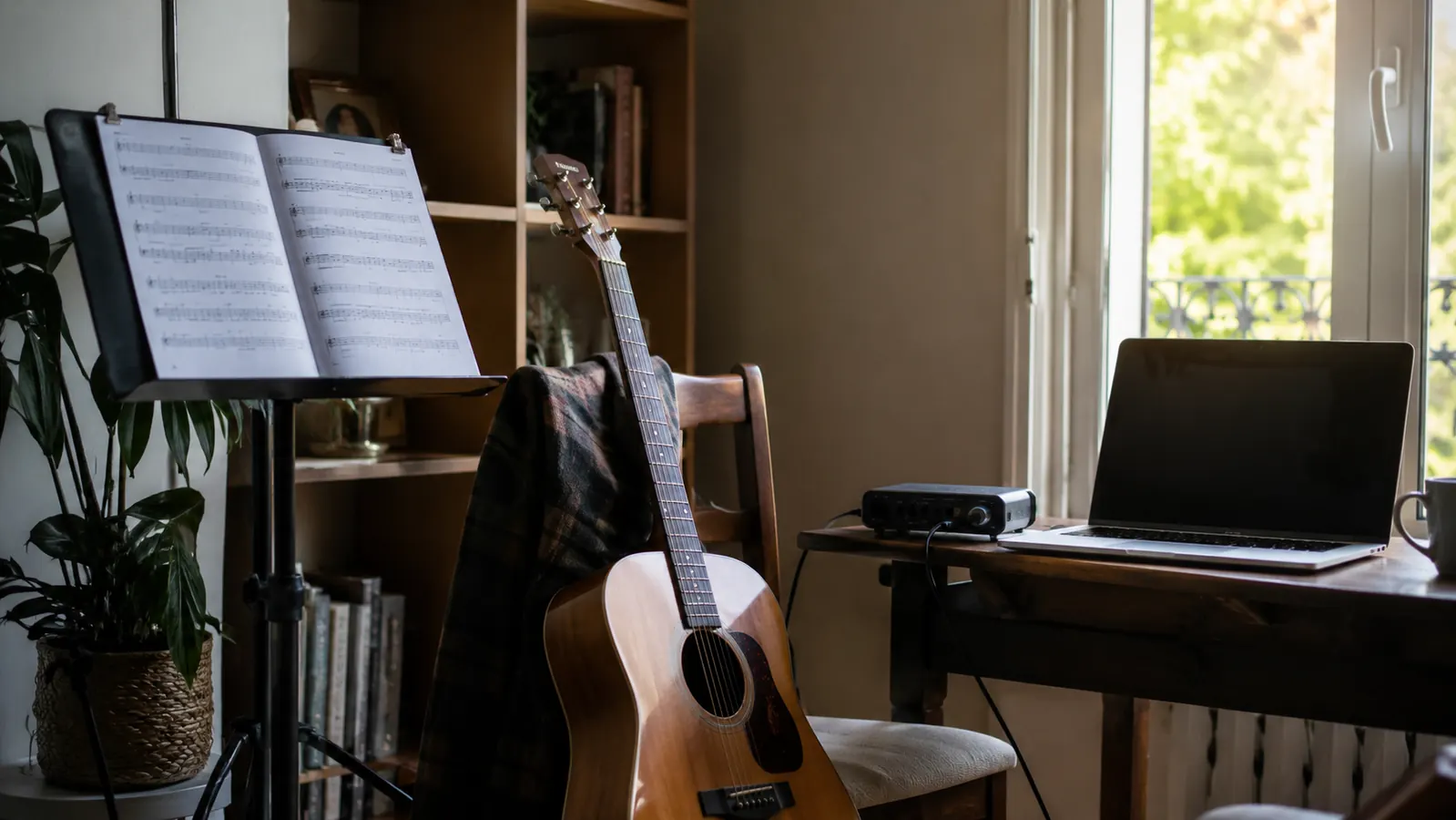
Your ears are a muscle, and they are trained most by what you play over and over. If most of what you hear is your own rushed, tired practice, that's the sound your ears learn to call normal. Recording changes the diet. When I keep the good takes in a folder and listen to them in the car, my ear starts to expect that sound, and the gap between my best and my average gets smaller every week. The recording is a reference library of the player you're becoming, and it costs nothing to browse.
The red light makes it a performance
Something changes when that record light is on. A performance has consequences, so a performance is honest. The same student who plays a scale fluently at the desk will rush it the instant the light goes on. That rush is the truth about whether the piece is ready, and practicing with the light on, all the way through, is the closest thing to stage repetition I can give a student before a real stage exists. I tell every student the same thing: play the piece like the show is tonight, then listen back like you're in the audience.
The recording knows the you that your ears miss
I call it second-take honesty. When you stop playing, you have an opinion about what you just heard, and it's usually a flattering one. Ten minutes later, playing the file back, you have a different opinion, and it's usually an accurate one. The recorder holds onto the version of you that only it knows: the fumbled chord, the beautiful accidental, the phrasing that worked, the ending that didn't. That second opinion is not judgment. It's the fastest feedback any of us get, and I'd rather hear it from my own playback than from a stage.
You pick up the skills of a studio for free
Learning to record teaches you how recording works. On the Scarlett Solo you learn gain staging without reading a manual, because when you clip the input you hear it instantly and you turn it down. You learn mic placement, because moving the mic six inches changes the whole sound and you can prove it on playback. You learn headroom, and quiet, and why a clean signal beats a loud one. Those skills transfer to any studio, any software, any band, for the rest of your playing life.
The best teaching device in my studio
The most useful tool in my studio isn't an instrument. It's the playback. When a student hears their own lesson back, the corrections I spent twenty minutes making land in ninety seconds, because they hear it themselves. One of my adult students, Marisol, records a fifteen-minute practice file every month, and it is the whole record of her progress. The recording is not homework and it is not a report card. It is a conversation with the player you were last week.
What I'd Skip
Don't buy an interface before you have something to listen through. Start with the speakers you already own, then get a decent pair of closed-back headphones before you chase better converters. And skip the fancy software at first; the recording program bundled with a budget interface is more than enough for a year. The gear that sticks is the gear that stays plugged in, and that's the argument this whole list is making.
When a student hears their own lesson back, the corrections I spent twenty minutes making land in ninety seconds, because they hear it themselves.
The audio interface that records without thinking
Every reason on this list has one requirement: an interface that stays plugged in, with a mic always connected, so recording is one click. The Focusrite Scarlett Solo is the one I've kept on my desk for eight years. Check today's price and make the habit yours.
Amazon Check Today's Price on Amazon →