

The first thing I do in any first lesson is not playing a note. It is tuning the guitar, and for years I watched students grind through it with a phone app held up to the strings, waiting for the microphone to hear them in a room full of other kids. Half the time the app could not pick out the string over the noise. The other half it heard the ceiling fan. Five minutes gone before a single chord was played.
Two weeks into the fall term last year, a seven-year-old put his guitar in its case during lesson three and refused to take it out. Tuning was the blocker. In his house, tuning meant waiting for his dad, and his dad dreaded it. So I clipped a tuner on for him, talked him through string six, and ten minutes later he had tuned the whole guitar himself. The green light did more for him than any speech I could give about practice.
Then I picked up a Snark SN-8 clip-on tuner for one of my weekend gigs, and I never went back to the apps. Clip it to the headstock, pluck a string, turn the peg, watch the needle center, move on. Thirty seconds for a six-string, in a room where a drummer is tearing through rudiments. I have now taught hundreds of students this exact routine, and every one of them can tune on their own after a lesson or two. Here is the method, step by step, exactly as I teach it.
The Snark SN-8 Is the Tuner I Hand to Every New Student
It clips onto the headstock, reads the string's vibration, and ignores every sound in the room. That is the whole job, and it does it in seconds.
Amazon Check Today's Price on Amazon →The 30-Second Tuning Routine
Step 1: Clip the tuner onto the headstock
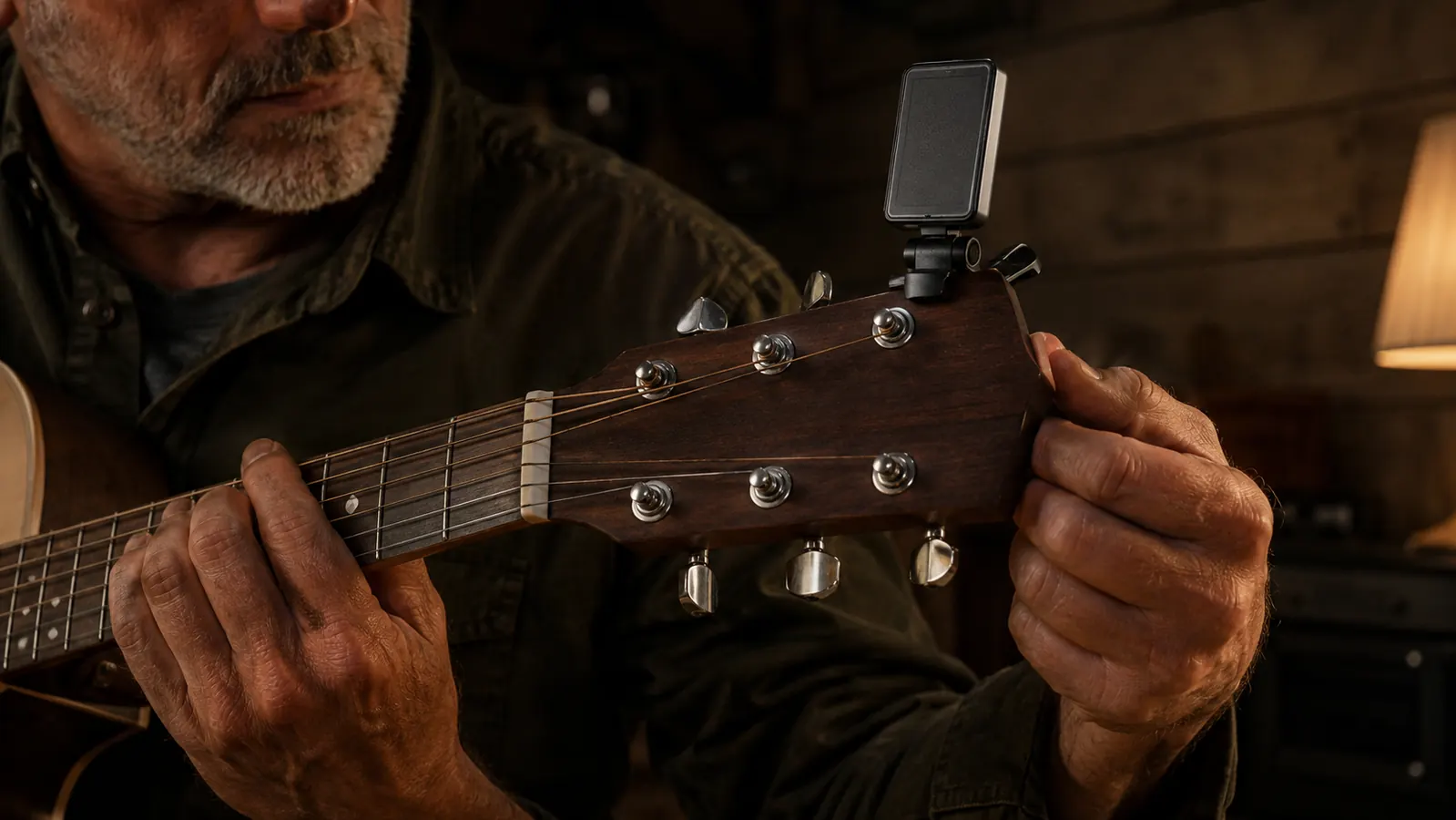
Anywhere on the headstock works, past the nut, near the tuning pegs. The Snark reads vibration through the instrument itself, so it does not need to be any closer to the strings than that. Clip it where you can see the display without craning your neck, and forget about it.
Some players clip to the rim of the soundhole instead. That is fine too, and it is what I do on violins and violas in group class, because their headstocks are too small for the clip. On a guitar, the headstock is the easiest spot, and it keeps the tuner out of your picking hand's way.
On an electric guitar, clip onto the headstock just the same, or onto the back of it if you want the tuner out of sight on stage. It needs a flat-ish surface to grip, so avoid the area right where the string posts come through. On acoustics I prefer the flat center of the headstock, facing me. If the display glares at an odd angle, the SN-8's display swivels, so tilt it until you can read it while you pluck.
Step 2: Give it a second to find the string
The SN-8 shows the note it hears as a big letter on the display, with a sharp or flat sign beside it when you are between notes. Do not start pegging away the moment it lights up. Pluck the string once, let it ring, and let the display settle. A string that is badly out of tune will jump around for half a second before it locks onto the right letter.
The default reference is A440, concert pitch, which is what every band, backing track and other instrument you will play with assumes, so most players never touch the calibration. If you are tuning for an ensemble that tunes sharp or flat on purpose, the tuner holds a quick calibration setting. For home practice, ignore it entirely.
Pluck at a relaxed volume. Hitting the string hard makes the needle flutter and hunt, and a hard attack on a fresh string can read sharp for a split second. Pluck normally with your thumb or pick, let the note fade, and the display settles where it should. And if the display ever goes dim or stops locking on, change the battery, a nearly dead one behaves exactly like a broken tuner.
Step 3: Pluck one string and read the letter
Start with the thickest string, the sixth string, low E. Pluck it with your thumb, roughly over the fretboard, and let it ring. The display should read E. If it reads something else, like D or F, the string is far enough off that the tuner locked onto the nearest note, which is normal on a badly slack new guitar.
Work in order from the sixth string to the first, E, A, D, G, B, E. That order matters because each string you tension pulls a little on the neck and shifts the others. Check them low to high once, then confirm the low E again at the end, and you are done in a single pass.
If the letter on the display does not match the string you plucked, stop turning pegs and find the right peg first. The single most common thing I see in lessons is a student turning the middle peg and wondering why the high E is not changing. Trace the string from the bridge to the headstock, then turn that peg and only that peg. Thirty seconds of checking is faster than a minute of cranking the wrong knob.
Step 4: Turn the peg until the needle centers
Here is the direction test that trips up every beginner. Tightening a string makes it sharper, loosening makes it flatter. If the needle sits on the sharp side, you are too tight, turn the peg the way that slacks the string. If it sits on the flat side, tighten up. The needle centers, and the display turns green the moment the string is on the pitch.
And always tune up to the note, never down. When you overshoot and the needle swings sharp, loosen the string past the pitch, then tension it back up to center. A string that arrives at pitch from the loose side holds its tuning. A string you loosened down onto the pitch stays stubborn and drifts sharp within a minute. This is the single tip that stops a student from retuning between every song.
How far to turn: a little goes a long way. A quarter turn of the peg is already several cents, enough to watch on the needle. Turn in small nudges once you are close, and give the needle a heartbeat to respond after each nudge. Beginners crank past the note, overshoot, and then fight the string down from the sharp side, which is exactly the loop the tune-up tip exists to break.
Step 5: Check a chord and walk away
Once all six strings center, strum a full open G chord and listen. The chord is the honest test, because a tuner centers each string against its open note, and the bow of the neck under full tension can throw an outlying string off by a hair. If the G sounds sour, pluck the guilty string and nudge it back to center, always arriving from the flat side.
New strings stretch for the first day or two, so a freshly strung guitar drifts flat while it settles, and that is normal. Give the G chord a recheck, give yourself ten minutes of playing, then re-center anything that moved. Nothing about the routine changes, it is the same three moves.
Once the routine is fast, run it before every practice, every rehearsal and every gig, out of habit, not because you heard something wrong. That is the professional habit, the one that separates players who sound in tune every time from players who only fix guitars that annoy them. One pass takes less time than counting to thirty, and it keeps the whole instrument trustworthy.
What Else Helps
A tuner does not fix an instrument that will not hold pitch. Old, dirty strings tune painstakingly and slip again within an hour, so a fresh set of strings is the best tuning accessory there is. Check the neck too. If your guitar has sat in a closet for three years, the strings are rusty and the action is high, take it in for a setup and it will feel like a different instrument.
For the room itself, the reason the Snark wins in my studio is that it ignores noise, because it reads the instrument, not the air. Phone apps still rule on the bus or at a summer camp with nothing to clip onto. But for lessons, rehearsals and gig bags, I own six clip-on tuners and keep one in every case I carry. Kids lose tuners, and there is no sadder sound than an out-of-tune violin in a group class with no spare.
One more thing worth knowing: if a fresh tuner, fresh strings and a normal setup still will not hold pitch, the guitar is telling you something. A warped neck, a cracked nut, or cheap pegs that slip under tension all show up as the same symptom, the string that drifts no matter how many times you center it. That is a repair bench conversation, not a tuning problem, and no tuner fixes it.

The Mistakes I See in Every First Lesson
Turning the wrong peg is the most common mistake, and it is an attention problem that a minute of tracing cures. Reading the wrong octave is second: the tuner shows the note letter, and a string tuned an octave low reads the same letter and still centers, but sits like wet spaghetti under your fingers. If a string feels slack and dead but the needle says it is in tune, it is an octave too low. Tighten it past the slack spot and it will snap into the right register.
Third is tuning down onto the note, which I covered above, because it drifts sharp the moment you move on. Fourth is plucking too hard and reading the vibration spike instead of the settled note. And the fifth is giving up, deciding you have no ear and tuning is for someone else. Nobody in the room fails to tune because of their ears. They fail because no one walked them through the steps in the right order, with the tuner doing five of the six jobs.
Here is the encouraging part: the tuner does the hearing for students, and the ear develops slowly, on top of a reliable in-tune instrument, over months of playing. I have had students of nine and ten teaching their parents this routine by the end of a term. Hand a kid a credible tuner and a two-minute walkthrough, and tuning stops being the chore that makes them want to quit.
Tune up to the note, never down. A string that comes to pitch from the loose side stays put, and a string you loosened onto the pitch drifts sharp within a minute.
For a beginner, tuning by ear is not a skill yet, it is a frustration that makes them want to put the guitar down. The Snark gives the first months of practice a quiet, pleasant start to every session, and it teaches pitch by showing you exactly when you are off. Clip, pluck, turn, done. That is the whole method I teach, and it takes less time than the intro to a pop song.
The Snark SN-8 Turns Tuning From a Chore Into a Habit
Clip it on the headstock and let it read the string. It is the fastest lesson I can hand a new player, and the battery lasts long enough that you will forget it is in there.
Amazon Check Today's Price on Amazon →